


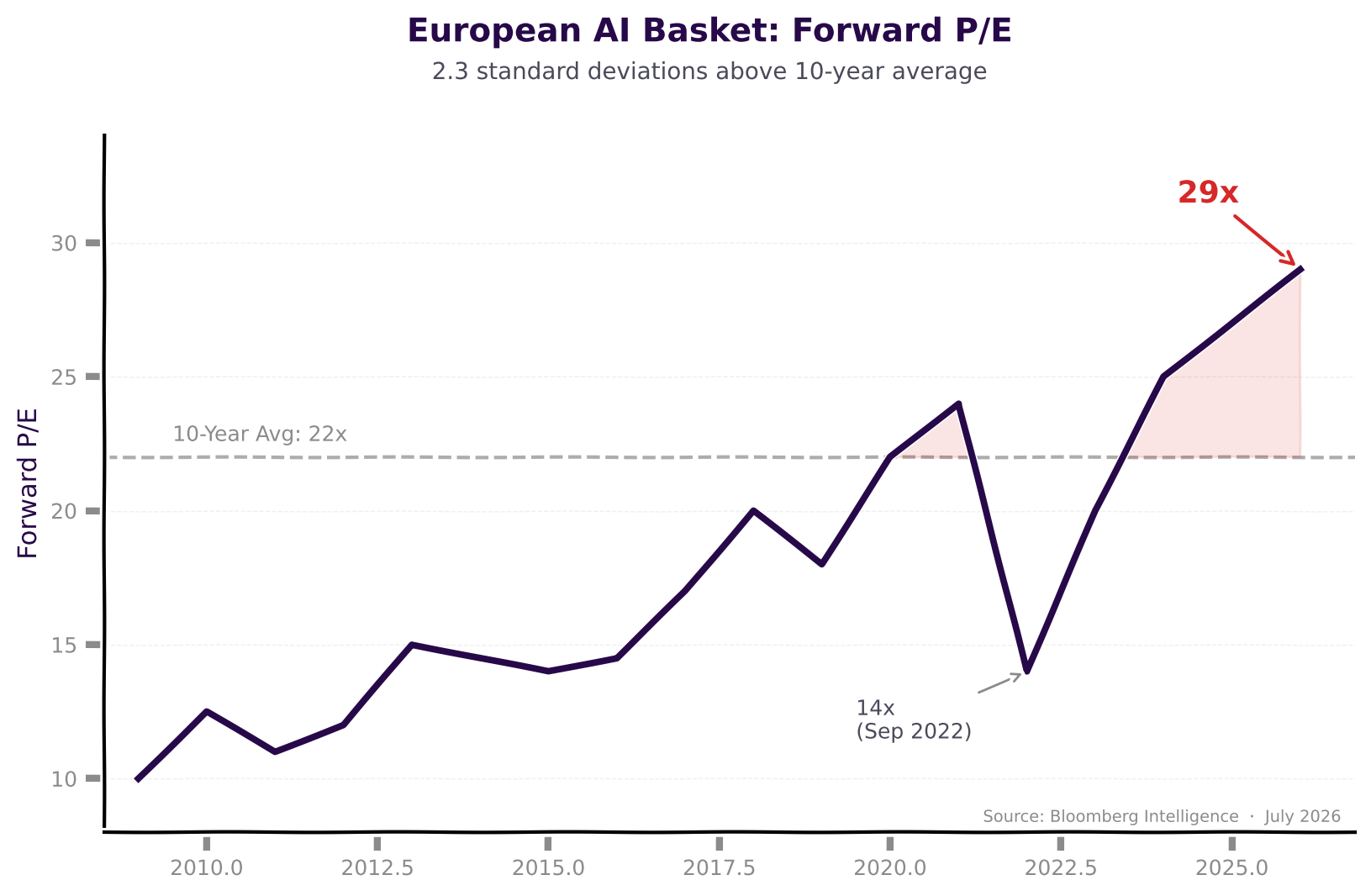
European AI stocks now trade at the widest premium within Bloomberg Intelligence’s global AI universe. BI’s 2026 midyear outlook quantifies the gap: the European AI basket sits at 28.9x forward earnings, 2.3 standard deviations above its own 10-year average, against 0.8 sigma for US AI and slightly below average for the global aggregate. The European basket has rerated 9% year to date while US and global peers derated 9% and 16% respectively.
The basket tracked by BI includes ASML, STMicroelectronics, Siemens Energy, Schneider Electric, Glencore and Prysmian on the hardware and infrastructure side. In software, only SAP and Capgemini make the cut, as the only two names explicitly linking AI adoption to business model change, despite that link not yet showing in their share prices.
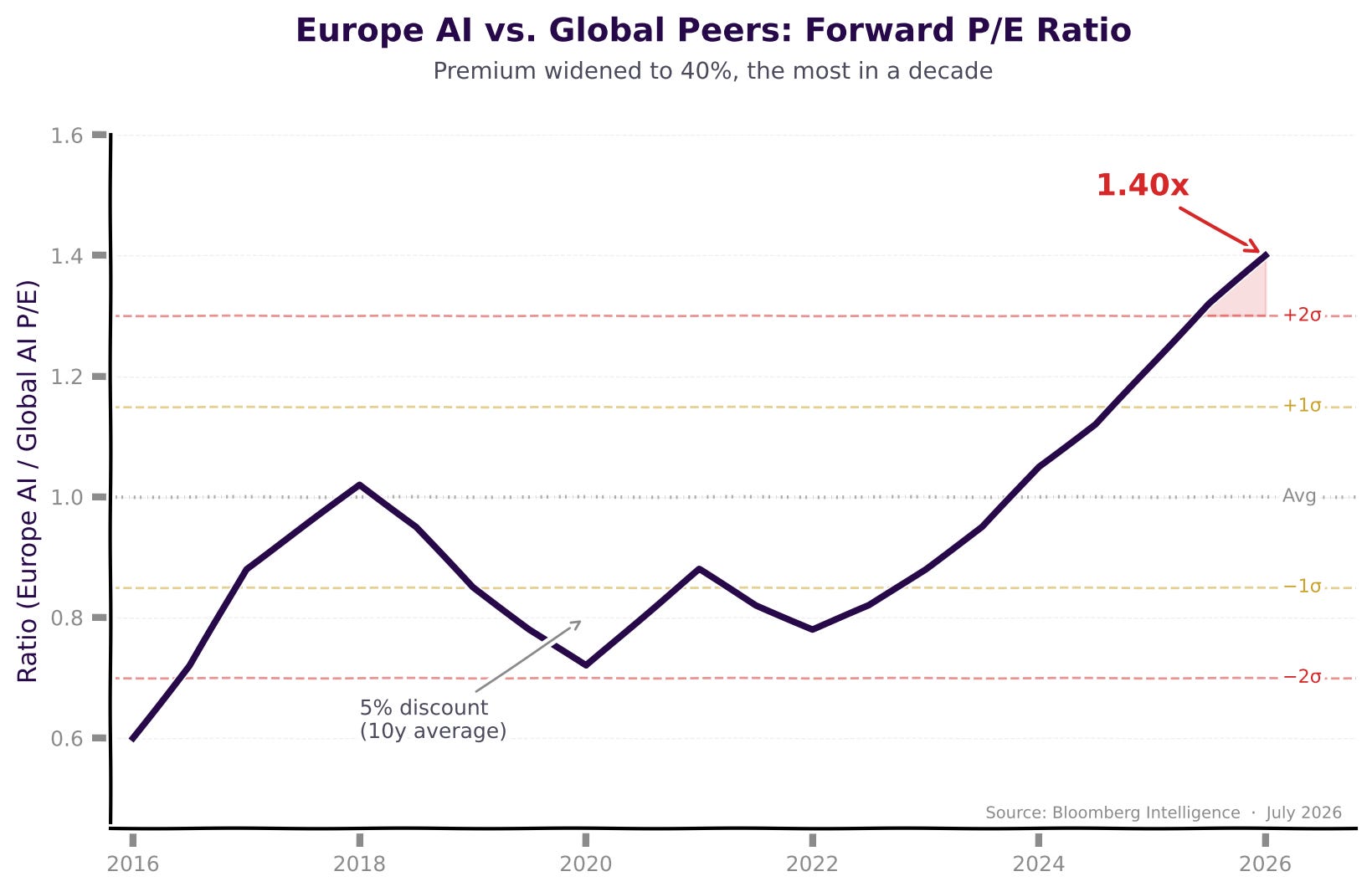
The premium to global AI peers has widened to 40%, up from a 5% discount averaged over the previous decade. The median PEG ratio tells the same story from a different angle: 1.4x for European AI against 0.6x for the global peer group, using an 18% earnings CAGR. Within the basket, STMicroelectronics, Nokia and Huber+Suhner sit at least 3.8 standard deviations above their own 10-year average multiples. When a theme can be expressed through only a handful of names in a given geography, scarcity can push multiples beyond what earnings growth alone would normally justify.
AI-related names, together with energy and financials, account for roughly 68% of the Stoxx 600’s 2026 EPS growth. Strip those three groups out and the index’s forward P/E falls below its 10-year norm. The rerating that makes European equities look constructive at the headline level is almost entirely driven by a narrow set of names trading at historically extreme valuations. Much of the capital flow behind this, as CrossBorder Capital and Damped Spring have documented, reflects portfolio diversification away from US assets since late 2024 rather than a bottom-up reassessment of European earnings power.
The AI basket’s 2026 EPS estimate has been raised 6% in the past three months with a 47% revision ratio, against a slight decline for the rest of the index excluding energy. AI-related constituents are expected to deliver a 26% EPS CAGR over the next two years. How much of it is already in the price, and whether the relative premium reflects fundamentals or simply scarcity, is what MacroFly would frame as the equity duration question for European markets.
Comparable exposure to the global AI factor is available outside Europe at a median PEG of 0.6x, against 1.4x for the European basket. If AI sentiment turns, European names carry the widest valuation cushion to lose. BI’s own fair-value model places the Stoxx 600 at 660, 8% below the bottom-up consensus target of 711, and the AI basket is where the compression would concentrate first. Our own GSY framework reaches a similar conclusion from a different direction: when strong price appreciation becomes increasingly detached from the underlying distribution of fundamentals, the market grows less tolerant of even minor earnings disappointments. The broader macro conditions that Michael Kao and Claudia Sahm track (Middle East resolution, ECB path, energy-led disinflation) will determine whether the premium holds or contracts.
ASML and TSMC have already provided the first earnings test: demand remained strong, but TSMC’s shares fell despite a 77% increase in quarterly profit. That is exactly the risk a 40% valuation premium carries: the earnings can keep delivering while the multiple compresses.
Source: Bloomberg Intelligence, European Equities Midyear Outlook, July 2026. Charts: 20Quant