


During Summer senior desks thin out, volumes shrink, and the gaps that open up between tradeable prices make it far easier for small catalysts to produce outsized moves. August 2024 was the textbook case: a modest US inflation miss cascaded into a 12% single-day collapse in Japanese equities and panicked talk of emergency Fed cuts.
This summer the conditions are at least as fragile. Here are the four pressure points we are watching.
1. The Fed under Warsh
Kevin Warsh has brought a fundamentally different communication style to the Federal Reserve. Fewer speeches, less forward guidance, a deliberate step back from hand-holding the market on policy direction.
In principle, reasonable. In practice, it leaves investors without a map at exactly the moment when the macro backdrop is unusually uncertain. Oil prices have ticked higher on the back of the Iran situation, and nobody has a reliable read on how Warsh weighs that against the rest of the inflation picture.
As Mohamed A. El-Erian has been writing on the interplay between the war in Iran and the Fed’s constraints, the risk is that markets are pricing in a degree of policy clarity that simply does not exist under this chair. Claudia Sahm has made a similar point on the structural limits of forward guidance when the reaction function itself is being redesigned.
2. The yen at 40-year lows
USD/JPY has pushed above ¥162, a level the pair has not reached since before the Plaza Accord. The chart below puts the current move in four decades of context.
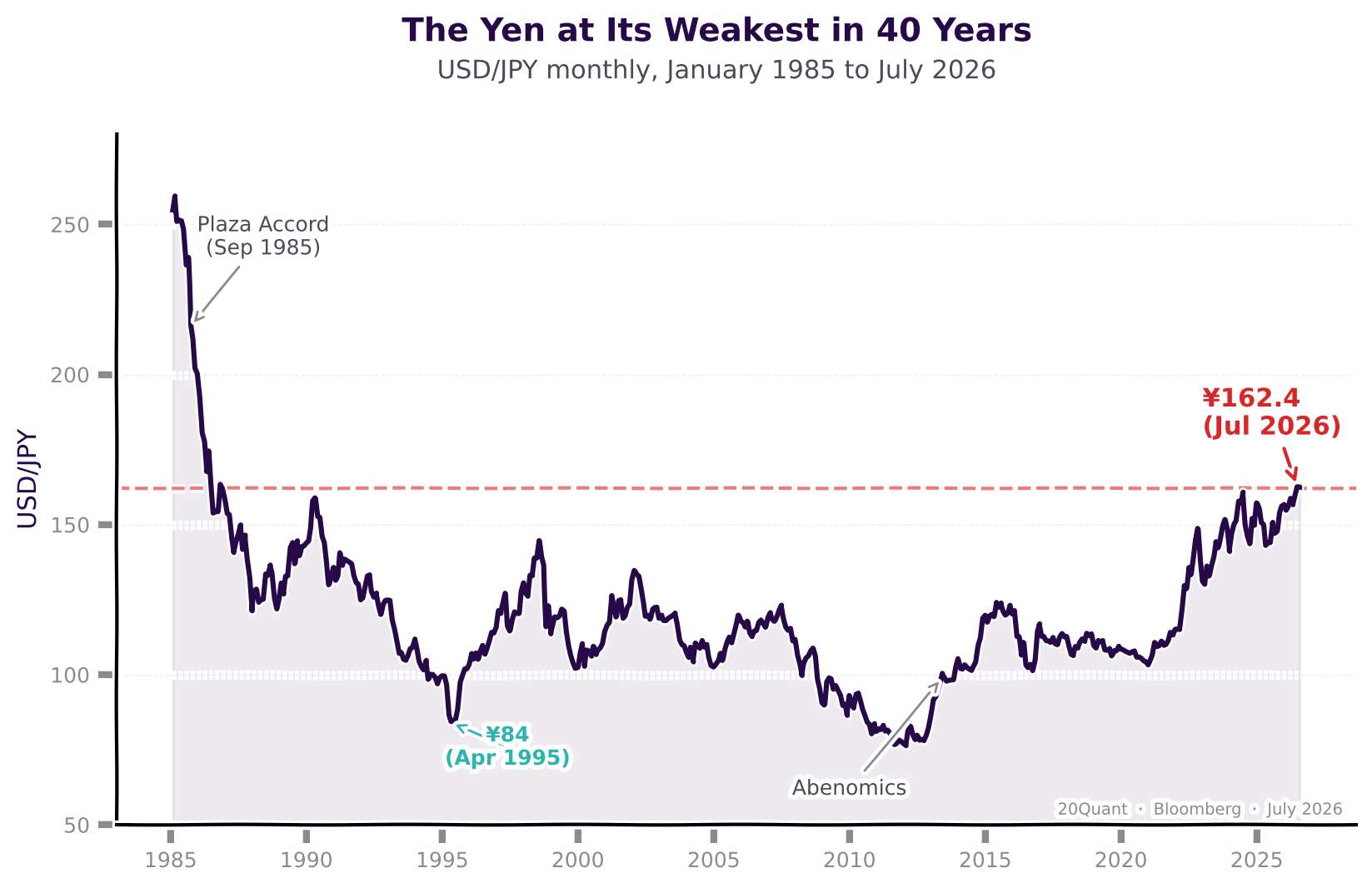
The carry trade setup is the same one that blew up in August 2024: cheaply borrowed yen funding positions across global markets, with the implicit assumption that Japanese authorities will tolerate continued weakness.
Weston Nakamura has been tracking this from Tokyo in detail, including the intervention mechanics and the forced selling dynamics that follow when the Ministry of Finance decides to act. The risk is not the intervention itself. It is that the carry trade unwind, once triggered, spills into US Treasuries and corners of the market that nobody is watching today.
3. Leverage keeps climbing
The Bank of England flagged this explicitly in its latest Financial Stability Report: borrowed money has been growing rapidly as a force behind equity markets.
Leverage does not cause a shock, but it amplifies whatever shock arrives. In a low-volume summer environment, that amplification can be severe.
4. The narrative vacuum
Coming into 2026, investors held a set of high-conviction positions: long gold, long big tech, cautious on oil.
Gold suffered its worst monthly drop since 2008, falling over 11% in June. Oil collapsed despite months of supply warnings. The six largest US tech names have shed roughly $2 trillion in market capitalisation since October 2025, according to Barclays. As MacroVisor has been documenting across asset classes, the problem is not that one trade stopped working. It is that all of them stopped working at the same time.
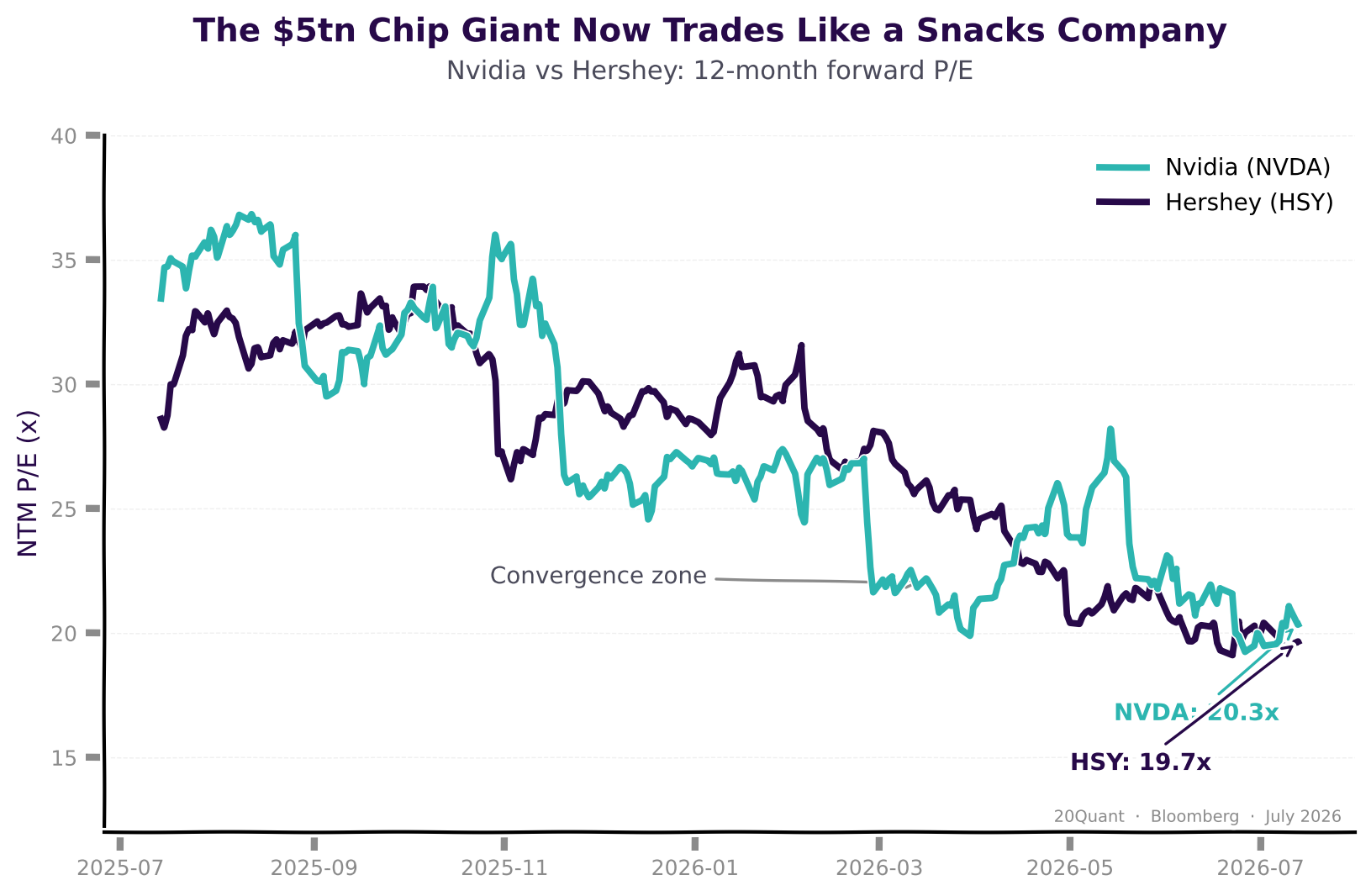
The valuation picture captures the shift in one image. Nvidia, the $5 trillion chip giant that defined the AI trade, now trades at roughly 20x forward earnings. Hershey, a snacks company, trades at the same multiple.
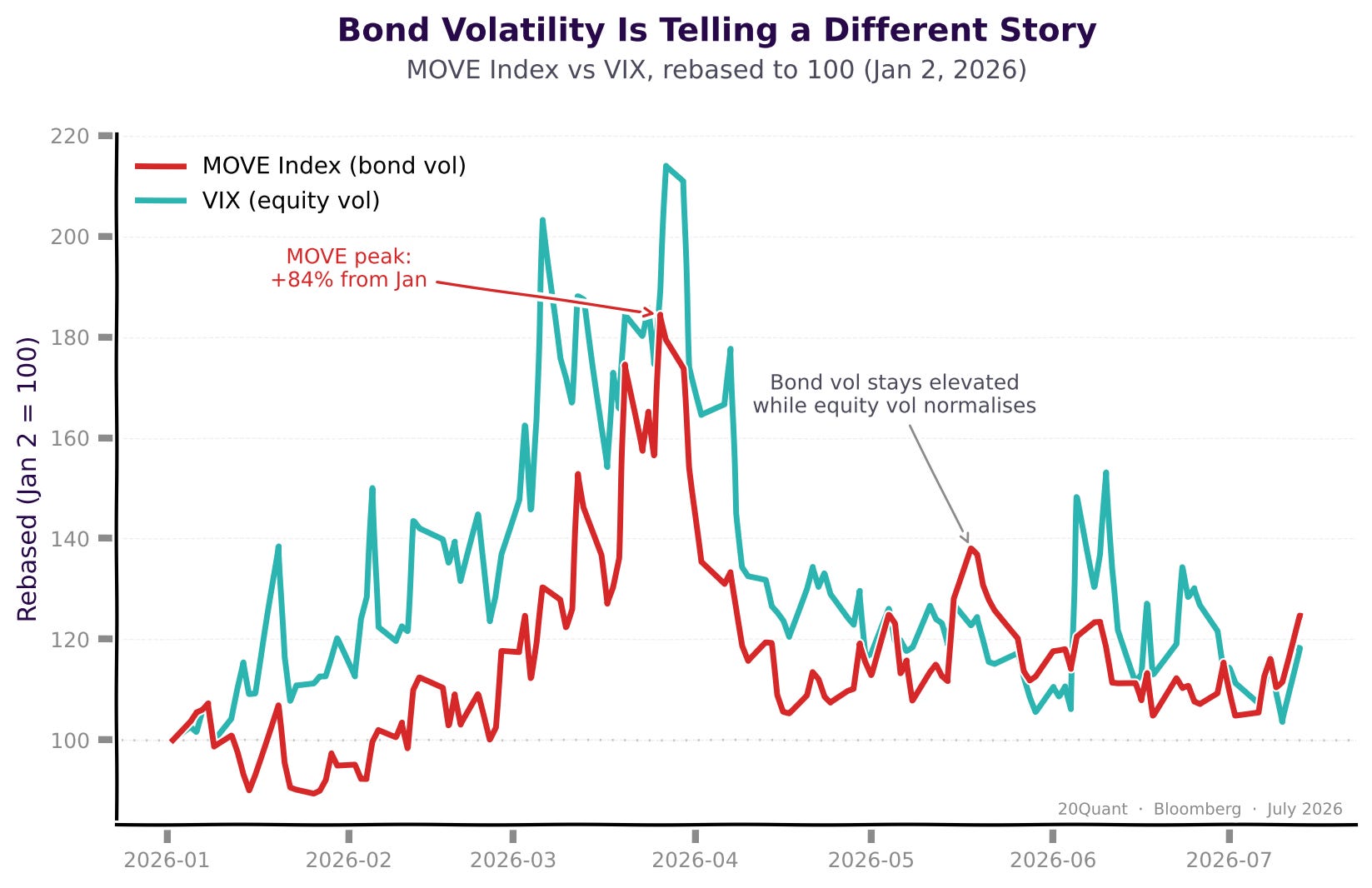
The MOVE Index spiked to nearly double its January level during March and has stayed elevated, while the VIX normalised quickly and has been drifting near 15 to 17. Capital Flows has been covering this rates-equity vol divergence in real time, and the implication is uncomfortable: the fixed income market is pricing uncertainty that equities have so far chosen to ignore.
As Vincent Mortier at Amundi summarised it recently, the only sensible response is to hedge broadly and diversify aggressively. The trades that defined the past year have stumbled, conviction is low, and the risk of summer dislocations is high. As Michael Kao would put it, the signal-to-noise ratio in macro has rarely been this poor.