

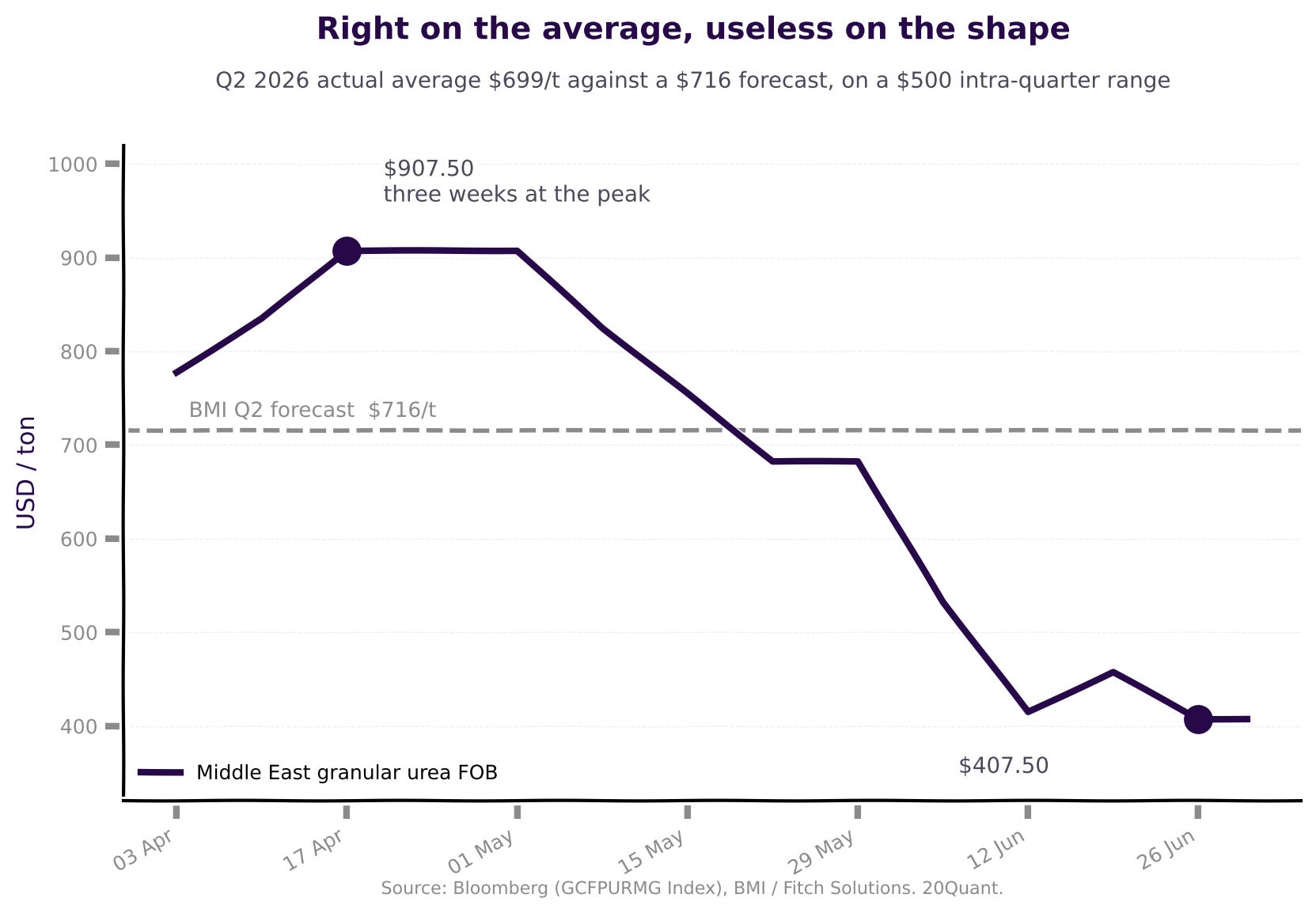
Middle East granular urea is quoted around $425 a ton, roughly half where it stood in April, and the decline is being taken as evidence that the Hormuz fertilizer disruption has passed. What the price is actually recording is demand leaving the market, which matters because a farmer who skips an application does not buy the missing nitrogen back later at the cheaper price. The corridor carrying about a fifth of the world’s crude, which we looked at from the jet fuel side in early July, also carries roughly a third of its urea exports, and that leg has had far less attention than the oil, Michael Kao ’s coverage included.
The reason to doubt that supply is normalising is on the feedstock side. TTF sits at its highest level of the year, above the March escalation peak, while ammonia has been falling since June.
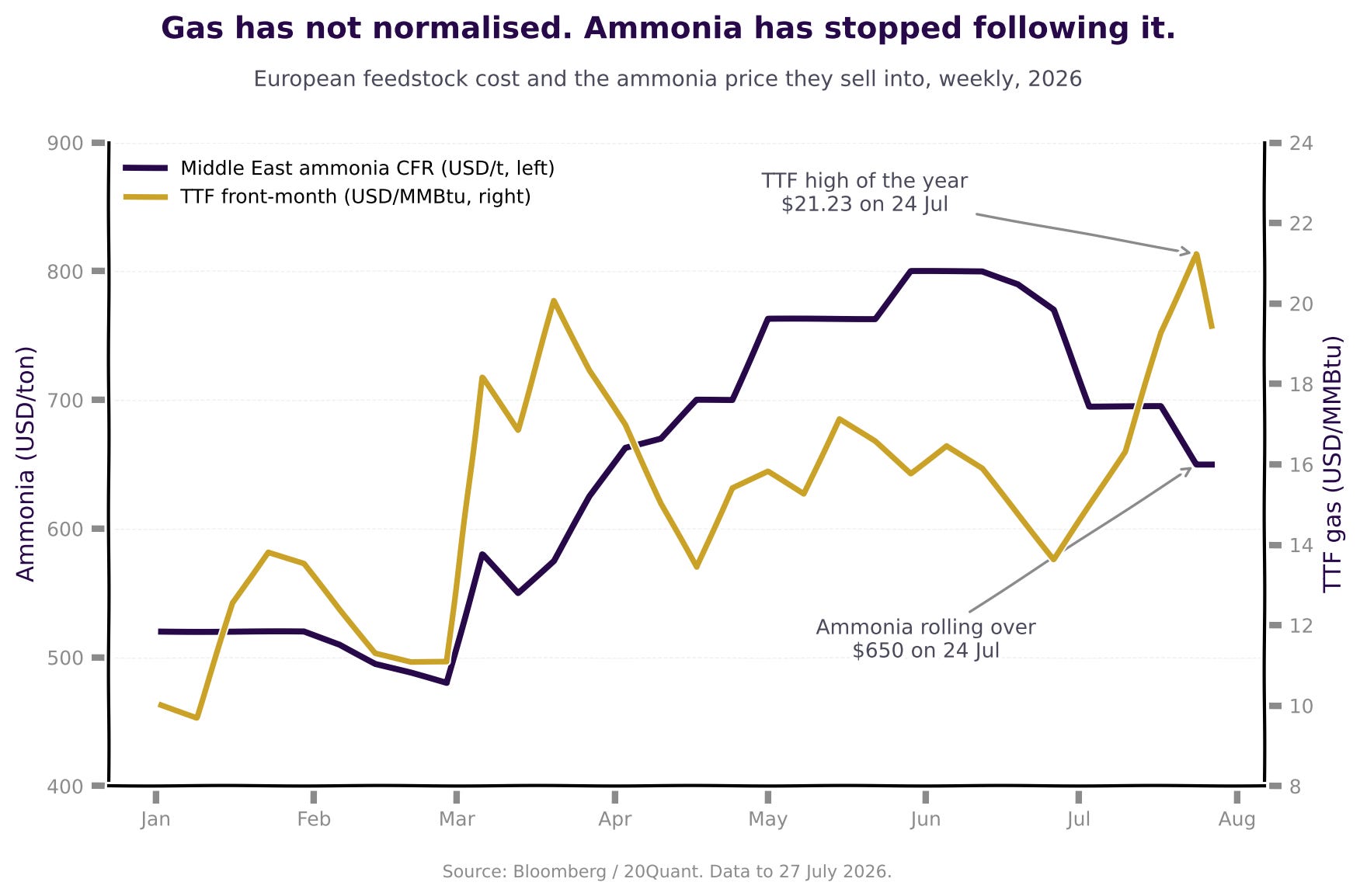
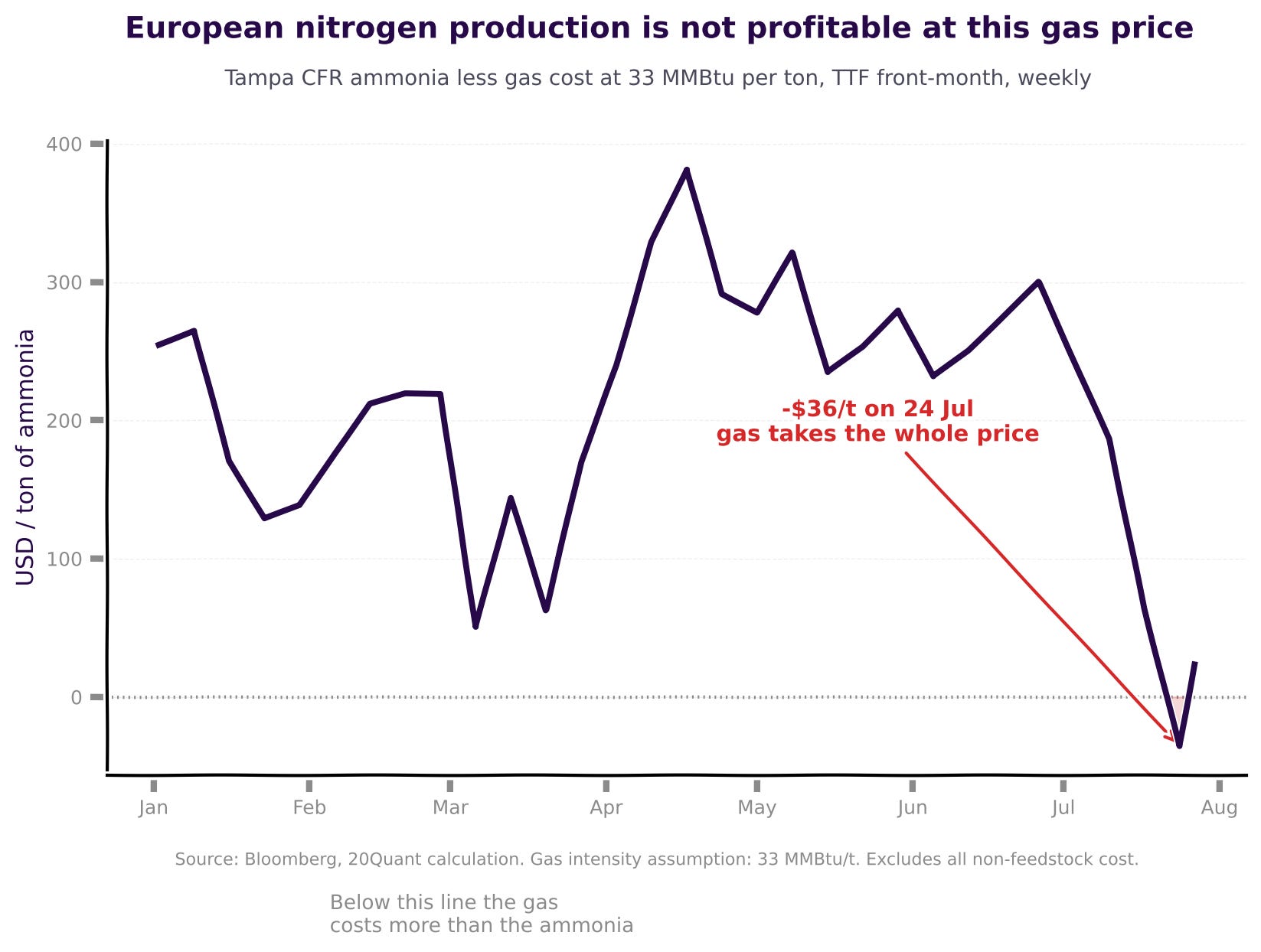
Gas is not one input among several for a nitrogen plant, it is most of the cash cost, and at current TTF the gas required to make a ton of ammonia costs roughly what the ammonia sells for. Agrofert’s SKW Piesteritz and Duslo have been running at technical minimums since March on that arithmetic, and the question is no longer when they return but whether European nitrogen capacity exists in the form it did two years ago. France has already responded with a €2bn plan to reduce fertilizer import dependency, which is a reasonable read of a capacity problem that outlasts the conflict. This is the European industrial cost problem MacroVisor has followed through this cycle reaching nitrogen ahead of most sectors.
For the harvest, the level of the price mattered less than its instability. Growers who needed nitrogen in April and May paid up to $907.50 a ton; anyone able to wait until late June paid $407.50. That happened while war-risk premia on Gulf transits tripled to $750,000 per vessel and the insurance mutuals withdrew cover altogether, so forward purchasing was unavailable precisely when hedging would have been worth most. Markets reprice geopolitical risk continuously, which is the frame Weston Nakamura works in, while a grower gets one purchasing window a season and takes physical delivery or does without. Faced with an input cost they cannot fix against a yield they cannot fix, they apply less, and that decision is closed for the season the moment it is taken.
Where subsidy or domestic capacity intervenes, the signal never reaches the farmer at all. India trimmed urea output when the Qatari LNG suspension hit feedstock, but heavy retail subsidy absorbs the cost fiscally and leaves application rates roughly unchanged, a distinction worth holding when reading Indian agricultural commentary of the sort Shankar Nath writes for a domestic audience. China has stayed insulated through domestic production and alternative routing, consistent with the industrial self-sufficiency Michael Pettis has documented for years. Europe has neither cushion, and France’s corn-planted area may shrink 10% as growers move to less nitrogen-intensive crops or leave land fallow.
None of this reaches a consumer price index through the fertilizer market. It arrives through the crop planted under the shock and sold a season later, which places the effect in 2026/27, by which point the fertilizer story will be a year stale and the inflation will look like it came from nowhere. Anyone treating softening agricultural input prices as a disinflationary signal has the sign backwards, since prices are falling because buyers withdrew, and that withdrawal is what tightens supply later. Whether the result is a one-off level shift or something more persistent is the question Claudia Sahm has worked on since 2021. The South African Reserve Bank has already held rates while flagging that renewed conflict could justify a hike, arriving early on the reaction-function problem Mohamed A. El-Erian returns to regularly.
Two things would change the picture, and the urea quote is neither. Reinsurers restoring Persian Gulf war-risk cover on close to pre-March terms would let growers buy forward again before Southern Hemisphere planting finishes, and European ammonia producers coming back from technical minimums would confirm a gas leg that urea has already assumed and TTF has not yet delivered.
Source: Bloomberg, processed internally by 20Quant. Data to 27 July 2026.